
1
People
Start with the people and communities IPCN is designed to serve.
Seniors • Families • Neighbors
How It Works
IPCN begins with trusted local access points, supports preventive engagement, connects people to clinical care when needed, and uses IPCN Connect to keep the journey visible.
From community access to connected follow-through.
Start with the people and communities IPCN is designed to serve.
Seniors • Families • Neighbors
Create access in trusted places where people already live, gather, work, and receive support.
Community Sites • Events • Home • Outreach
Bring appropriate preventive services closer to everyday life.
Screenings • Education • Vaccination • Wellness
Connect identified needs to qualified clinical expertise and appropriate next steps.
Clinical Review • Referrals • Care Coordination
Support continued care beyond the initial encounter when appropriate.
CCM • RPM • BHI • Monitoring • Follow-Up
Track what happened next so needs, referrals, and support do not disappear after the encounter.
Follow-Up • Completion • Continuity • Insight
Helping preserve identity, place, action, provider involvement, follow-through, and insight across the care experience.
Identity → Place → Action → Provider → Follow-Through → Insight
IPCN Connect
The Big Picture
IPCN Connect links engagement, referrals, coordination, support activity, and reporting so the next step does not disappear after a community encounter.
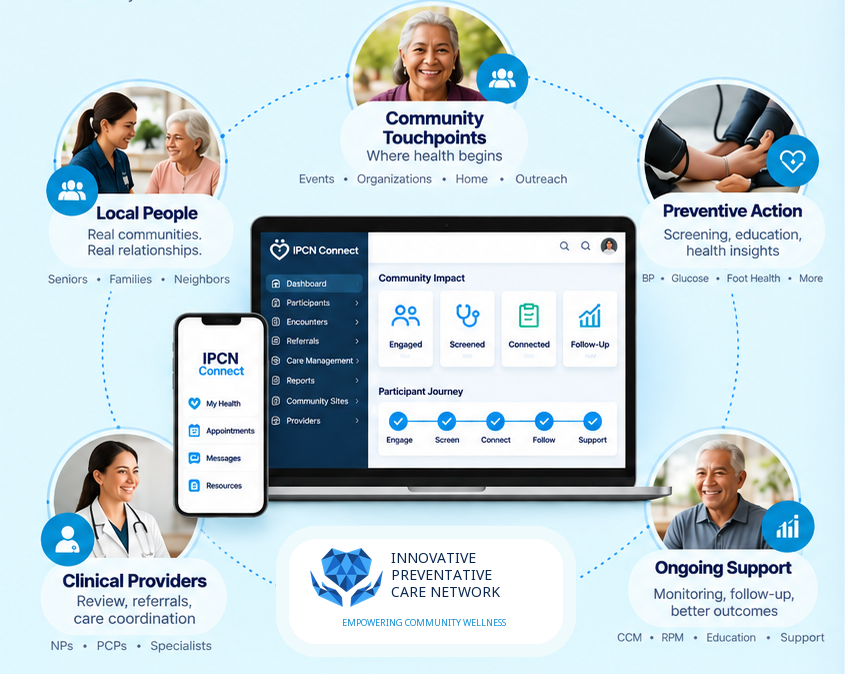
Designed to meet people where they are.
Designed to find and address needs sooner.
Designed to connect care across the journey.
Designed to support long-term wellness.
Local access. Connected care. Healthier communities.
How IPCN Connect Works
Identity → Place → Action → Provider → Follow-Through → Insight
IPCN Connect captures the context behind every care interaction — what happened, where it happened, who was involved, what action followed, and whether the care loop was completed.
Keep the journey connected to the same person.
Preserve continuity around the same person across appropriate interactions and stages of the care journey.
Know where care begins.
Capture the community touchpoint, home, outreach setting, or clinical location where the interaction occurred.
Know what happened next.
Follow preventive findings through clinical review, referrals, care management, monitoring, and follow-up.
Know who was involved.
Preserve which qualified care role, professional, community team member, or care partner was involved at each step.
Know what progressed and what remains open.
Distinguish an initiated or pending activity from verified completion where applicable.
Turn individual actions into population intelligence.
Connect longitudinal activity to reveal engagement patterns, unresolved needs, completed care loops, and opportunities for follow-up.
Helping preserve identity, place, action, provider involvement, follow-through, and insight across the care experience.
Identity → Place → Action → Provider → Follow-Through → Insight